Americano vs Mexicano: which format should your padel night use?
Both formats rotate players and score by points, but one draws the whole schedule upfront and the other rebuilds it every round. Here is how to pick.
If you have organised more than a couple of padel socials, someone has asked for a Mexicano. And if you have run a few Americanos, you may not be sure what actually changes when you say yes.
The short version: both formats rotate partners, both score by points rather than sets, and in both nobody is eliminated. The difference is when the schedule is decided.
- An Americano draws every round before the first serve. Player 3 knows they will partner player 7 in round five.
- A Mexicano draws round one at random, then rebuilds every following round from the live standings.
That single difference changes how the night feels, so it is worth picking on purpose.
Pick Americano when the group is mixed
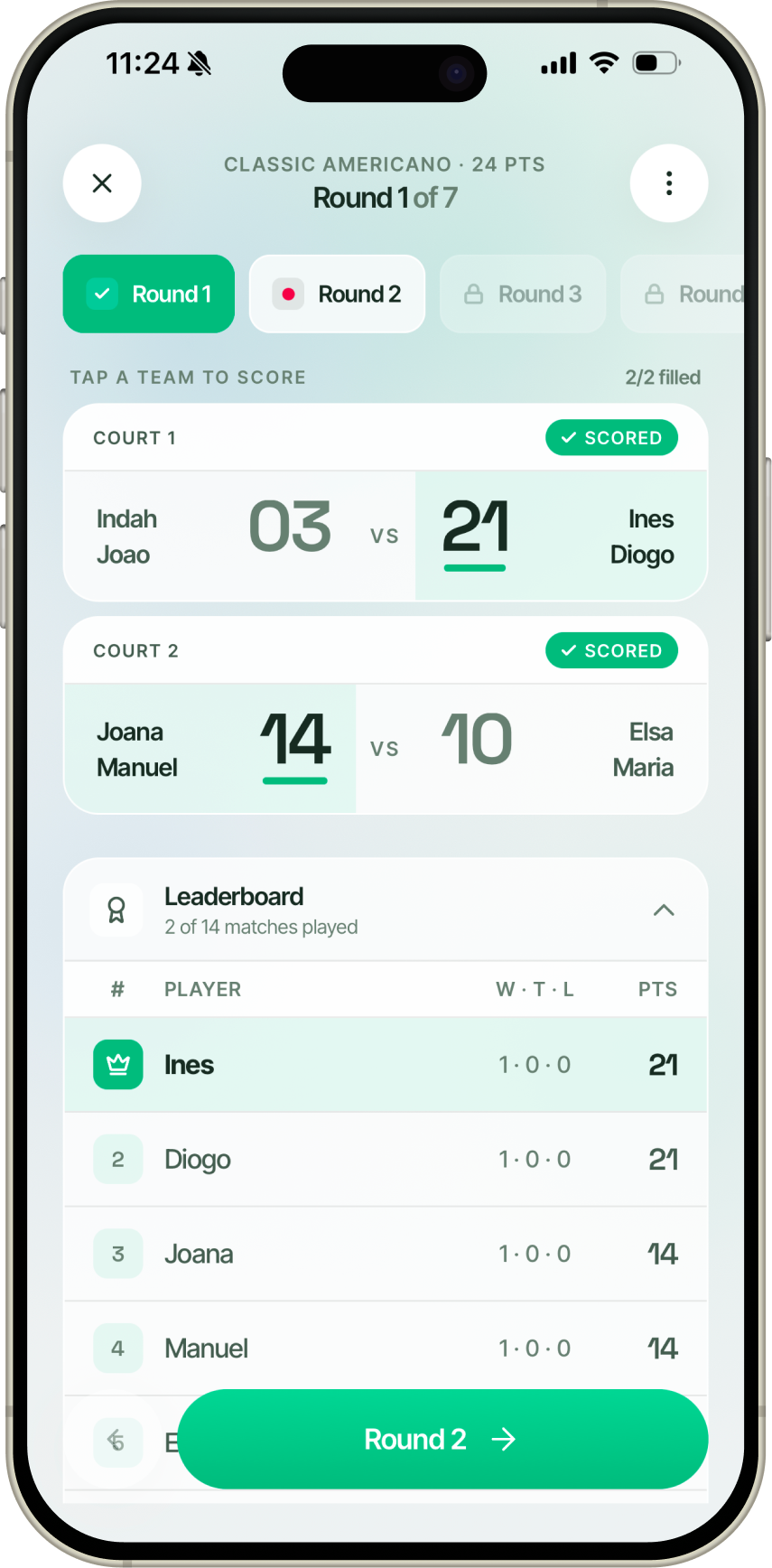
An Americano is the fairness format. With 8 players it produces 7 rounds in which every player partners every other player exactly once. Nobody can complain about the draw, because the draw covers everyone equally.
That matters most when levels are uneven. A weaker round with one partner gets balanced by a stronger round with the next, and because points are individual, a 14-10 loss still puts 10 points on your total. Beginners are not punished for being drawn with another beginner, they just play.
It is also the format to choose when the night has a hard end time. The schedule is fixed, so you know before you start how many rounds there are and roughly when you will be done.
Choose Americano if: the group is socially mixed, people care about a fair draw, or you have booked the courts until exactly 9pm.
Pick Mexicano when the group is competitive
A Mexicano is the tension format. After each round, players are sorted by total points, split into groups of four in rank order, and within each group the 1st and 3rd play the 2nd and 4th.
The effect is that matches get tighter as the night goes on. Win early and you climb into harder company. Have a bad round and the field pulls you back toward players at your current level. By round four, the top court is usually the four strongest players in the room, playing a genuinely close match.
The trade-off is predictability. There is no set number of rounds, so a Mexicano ends when the court time runs out or when the group decides it has had enough.
Choose Mexicano if: levels are reasonably close, the group is there to compete, or you want the last round to be the best one.
The four variants of each
Both series come in the same four flavours, so the Americano-vs-Mexicano decision is separate from the pairing rule:
| Variant | What it fixes |
|---|---|
| Classic | Nothing. Anyone can partner anyone. |
| Mixed | Every pair is one man, one woman. |
| Team | Pairs stay together; only opponents rotate. |
| Club | Two clubs, and a player never faces their own side. |
So “Mixed Mexicano” is exactly what it sounds like: standings-based redraws, with the constraint that every pair stays mixed. All eight are on the formats page.
The practical answer
If you are running a club night for a group that changes week to week, default to Americano. It is easier to explain, easier to arrive late to, and nobody feels the draw went against them.
If you are running a night for the same eight regulars who all know exactly where they stand, run a Mexicano. They will get the close matches they came for.
And if you genuinely cannot decide, run an Americano first. It gives you a full points table for everyone in the group, which is exactly the seeding data a Mexicano wants next week.