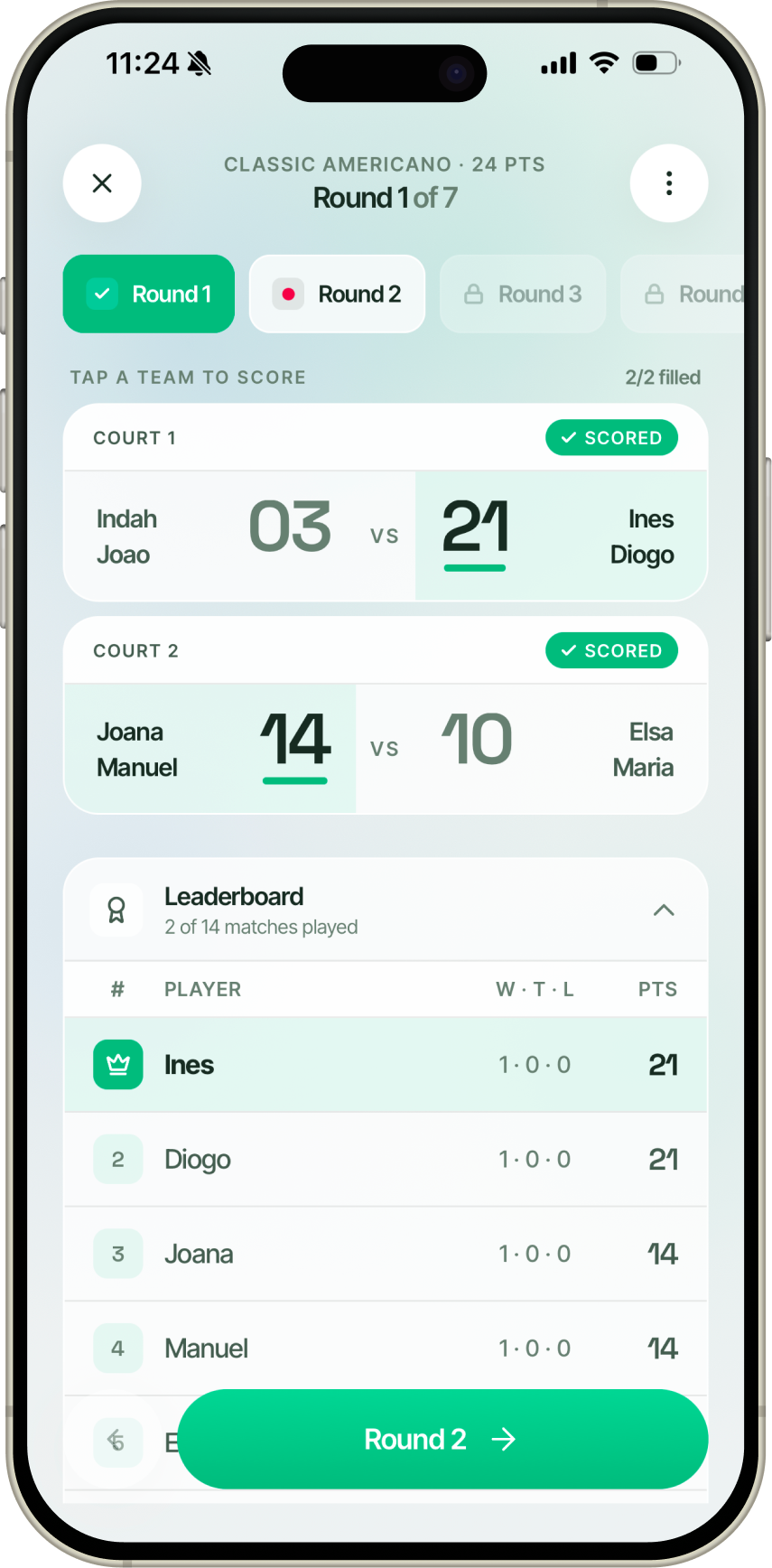
How to run a padel Americano: an organiser’s checklist
Players, courts, points target, rotation and sit-outs. Everything you need to decide before the first serve, plus the numbers that actually work.
Running an Americano is not complicated, but almost every decision that makes the night good gets made before anyone hits a ball. Here is the order to make them in.
1. Count the players, then round to four
An Americano needs at least 4 players and works with any number above that. But the number decides whether anyone sits out:
- Multiples of 4 (8, 12, 16): everybody plays every round. This is what you want.
- Anything else: some players rest each round, and the schedule has to rotate those rests fairly.
Eight players on two courts is the sweet spot. It gives you 7 rounds in which every player partners every other player exactly once, which is the cleanest possible Americano.
If you land on an awkward number like 10 or 13, do not send anyone home. A well-drawn schedule spreads the sit-outs so nobody rests twice before everyone has rested once. It is worth checking that whatever you use to draw the schedule actually does this, because doing it by hand is where most whiteboard Americanos fall apart.
2. Work backwards from your court time
This is the calculation organisers skip and then regret.
Take your booked time, subtract 10 minutes for arriving and explaining, then divide what is left by your round length. A round to 24 points takes roughly 12 to 15 minutes including the changeover.
90 minutes booked − 10 minutes setup = 80 minutes ÷ 14 = 5 to 6 rounds
Now check that against the schedule length. Eight players want 7 rounds for a complete rotation. If you only have time for 5, that is fine, but decide it upfront rather than cutting the night short mid-round.
3. Pick the points target
Americano matches run to a fixed point total rather than games and sets. Both teams keep scoring until the target is reached, so the two scores always add up to the same number.
| Target | Round length | Use it when |
|---|---|---|
| 16 | ~8 min | Many players, short booking, lots of rounds |
| 24 | ~13 min | The default. Long enough to be a real match |
| 32 | ~18 min | Small group, long booking, fewer rounds |
Twenty-four is the right answer most of the time. Sixteen starts to feel like a warm-up; thirty-two makes a bad pairing feel very long.
4. Explain the scoring once, clearly
The one thing new players get wrong is thinking they need to win. They do not. In an Americano, the points you score are yours, whatever the result.
Say it in exactly these words at the start:
Every point you score goes on your personal total. If you lose 14-10, you still bank 10 points. So keep playing hard even when the match is gone.
This single sentence changes the whole night. Without it, players who are 20-4 down stop trying, and the format falls apart.
At the end, the highest total wins. Point difference breaks ties, then match wins.
5. Decide who tracks the scores
You have three options, in descending order of how well they work:
- Every court enters its own score. Fastest. Nothing bottlenecks on one person.
- One organiser walks around collecting scores. Works, but you become the delay between rounds.
- A whiteboard. Works right up until someone rubs it, or you realise round four has a repeated partner in it.
Whatever you use, the next round should be visible the moment the last score is in. Dead time between rounds is what makes a two-hour social feel like three.
6. Have an answer for latecomers and dropouts
Someone will be 20 minutes late and someone will leave early. Decide now:
- Late arrival: either add them and redraw the remaining rounds, or hold them for the next tournament. Adding mid-Americano means the “everyone partners everyone” guarantee no longer holds, so say so out loud.
- Early leave: finish the current round, then drop them. Their existing points stay on the board but they will stop climbing.
Neither is a disaster. Announcing the rule before it happens is what keeps it from becoming an argument.
The short version
| Decision | Safe default |
|---|---|
| Players | 8 (or any multiple of 4) |
| Courts | Players ÷ 4 |
| Points target | 24 |
| Rounds | Court time ÷ 14 minutes |
| Scoring | Individual points, losses still count |
Everything above is what PadelEasy does when you create a tournament: it takes the player list, draws every round with no repeated partners, rotates sit-outs, and updates the standings as scores come in. If you would rather not do the arithmetic on a whiteboard, Classic Americano has the full rules and an example schedule.